Wednesday, July 30, 2014

The Saga of Summer Learning Part II: Karma Kicks In


You may recall an amusing blog series we posted last summer detailing the important role that summer plays in youth development.  Our Executive Director, Maggie Riden,  talked about her parents' brilliant creativity in signing her up for a summer theatre camp in the hopes that a new space would motivate her to try and learn to read and end her protracted campaign of summer tutor torture. In the spirit of continuity, we’d like to share with you Part II of that saga: 

Fast-forward nearly 10 years. I was 17 and it was the summer after my senior year. I was desperate to save enough money to avoid working my first semester of college. So to compliment my ice cream scooping job at Friendly’s,  I signed up with the local elementary schools to work as a summer tutor.

In the weeks leading up to my first session, I remember diligently tracking down worksheets and lesson plans from teachers and the library, neatly filing them into a variety of folders. I recall carefully writing out spelling words and math facts on index cards.  What I don’t remember as clearly (but she loves to mention it) is the look of utter amusement as my Mother watched me.  She gently suggested that given the kids I’d be working with, maybe I should consider a different approach than worksheets and rote memorization at a desk. She even offered her special education expertise to help me come up with some ideas. I, with the arrogant certainty that defines adolescence and early adulthood, scoffed at the suggestion that I didn’t know what I was doing.

Oh the irony. 

Two weeks later I found myself in one of those amazing life moments when karma catches up with you and not only smacks you in the face, but laughs with glee while doing so.  It was my second or third session with “Kevin”.  I remember sitting at his kitchen table watching in disbelief as he athletically tossed a massive pile of 3x5 index cards into the air, launched himself out of his seat, leapt over an ottoman and then slid with the practiced ease of a baseball player into the bathroom deftly locking the door behind him.

20 minutes and numerous bribery offers later, Kevin emerged.  

I arrived home frustrated and embarrassed and attempted to relay the incident to my Mom. Once she had stopped laughing and regained the ability to speak, we sat down and she helped me come up with some teaching strategies that were good for him. I can say with certainty, we never sat at his kitchen table or at his desk again.

For Kevin school was a frustrating and anxiety filled place. To ask him to replicate that setting with the added stress of 1:1 attention as he exposed his weaknesses (all while watching his brother play outside on a lovely summer afternoon) was never going to work, and it was borderline cruel to expect it to. So we turned his backyard into a giant clock to teach him how to tell time. We did math fact foot races with the neighbors. We incentivized reading by celebrating the completion of each goal with a scavenger hunt based on the theme of the book (he was into nature and we lived in Vermont which made it fairly easy).
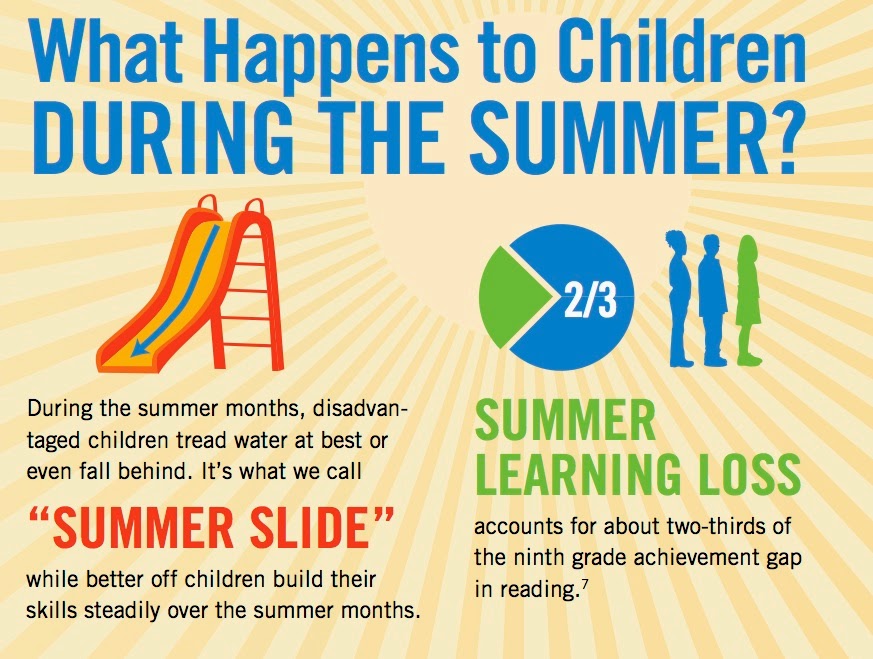
Info-Graph: National Summer Learning Association 
For kids who struggle to learn or face barriers to academic progress, summer has to be a part of the learning equation. Summer learning loss is real, it’s cumulative, and it’s a major contributor to the achievement gap. However, as Kevin demonstrated, that doesn’t mean summer should be more of the same.  Learning can take many forms. Summer is a chance to see what works, to allow children and teachers the time to explore, and ultimately, it's a prime opportunity to engage developing brains in new and exciting ways.  

DC is fortunate. We live in a city with many organizations and educators that embrace the opportunity of summer. They are creating spaces that build the skills and academic confidence of those who may be struggling, and challenge high fliers to aim for even greater heights. 

However, despite improved funding and increased availability, there are still thousands of children who don’t have the chance to enjoy the opportunity of summer learning - but would benefit deeply. So, DCAYA would like to pose two challenges.

First, we need to do a better job of explaining to all parents the benefits of summer learning programs.  We need to be clear that signing up for a summer program is critical to a child’s academic, social and emotional success.

Second, we must message to policy makers that we need universal access and a range of programs that ensure youth can access opportunities that excite them, and provide what they need as they grow and mature. To achieve that, we must have smart funding and strong partnerships between schools, community organizations, parks and recreation and libraries. This must be a priority.

Kevin and I, like many of you, were lucky. Our parents and teachers got it. They realized early on that we would need additional support throughout our academic careers and that our learning styles would require multiple approaches. Many of which could not occur sitting at a desk. Isn’t that an opportunity we should extend to all our kids? 


Maggie Riden learned spelling words and history facts by setting them to music, recording herself singing them, and then playing them over and over again on a Walkman while jumping on a trampoline. All strategies she credits her Mother, a special educator and multi-modality teaching savant, with coming up with. 


For more on youth issues in DC you can FOLLOW us on Twitter, LIKE us on Facebook, SUBSCRIBE to this Blog and VISIT us at www.dc-aya.org 

Wednesday, July 23, 2014

Makayla's Letter from Camp

Summer learning is often thought of as an “extra,” something nice, but not necessary.  However, more and more research shows that summer learning is critical in a child’s development.

Summer learning prevents the “summer slide”- when kids lose up to three months of what they learned in the previous school year, especially in math.  It allows kids to explore their interests, enhance their skills, and discover alternative ways of learning.


But enough of us policy wonks talking. Reports and research may statistically show why summer learning is important, but 7th grader Makayla says it best as she takes us through her day at Kid Power, Inc in her Letter from Camp:


Letter from Camp

Hello my name is Makayla and I am a camper at Kid Power summer camp. I am 11 years old and I am going to the 7th grade. I am going to tell you what Kid Power is all about!

In the morning we sign in and have the choice of going to the gym or going downstairs to eat breakfast. We have three main classes: Math, ELA, and VeggieTime.

In math we use baseball statistics to go over skills like fractions and division. The teams that I follow are the Angles, the Nationals, the Pirates, and the Yankees. Go Nationals!


ELA is also called film class. In film class we watch movies and fill out a storyboard so we can understand the movies better. The storyboards include main characters, supporting characters, setting, and plot.

In VeggieTime, we either tend to our garden or exercise in “VeggieTime Moves”. In the garden we water the plants, identify what’s growing, weeds, and harvest crops. We even got to paint signs, fences, and decorations to make it look beautiful. 


VeggieTime Moves is when we go outside or in the gym and exercise. For example, recently we did “Kid Power Cardio,” which is like Zumba, in the gym. It was a lot of fun!


After the three classes, we go downstairs for lunch. We eat and have some free time during recess. Every Tuesday, the Middle School Camp goes to the pool. The afternoons we don’t go to the pool, we have enrichment. The classes are tennis, cooking, and the Hot Sauce Challenge.

Tennis class is a lot of fun. We go outside to the tennis courts and learn skills like serving, backhands, forehands, and volleys. I played my counselors Miss Katie and Mr. Wendall, but I don’t remember who won. (Probably me!)

During cooking we use plants from the garden to make healthy snacks. In one class we made homemade ranch dressing using sour cream, salt, pepper, garlic powder, onion powder, and parsley we had grown ourselves.


The Hot Sauce Challenge is where every class makes their own hot sauce to sell. The money that we make selling it is going to be donated to a charity of our choice. We made our own recipe and will market it with our own logo and slogan!

Ever Friday, Middle School Camp goes on a field trip. Some of our recent field trips have been to the beach, a scavenger hunt around the community, and a field day with volunteers from Hanover Research. This Friday we are going to American University for a campus tour and later in camp we are also going to Splash Down Water Park!

In conclusion, I would like to thank all the staff, coordinators, and supporters of Kid Power. I think Kid Power is a very fun and exciting summer camp. I think all kids should join! I will definitely be back next year! 


Kid Power is an expanded learning member of DC Alliance of Youth Advocates. Kid Power specializes in youth development by promoting academic advancement, physical and emotional wellness, and positive civic engagement in underserved communities throughout the District. Find out about other expanded and summer learning programs in the DC area by visiting the DCAYA website at www.dc-aya.org. 


For more on youth issues in DC you can FOLLOW us on Twitter, LIKE us on Facebook,SUBSCRIBE to this blog and VISIT us at www.dc-aya.org.

Friday, July 11, 2014

D.C.’s Second Chance System


With the establishment of D.C.’s first Re-Engagement Center approaching this fall, DCAYA and our community partners have a growing interest in the need to align a robust re-engagement system to the frontline work of the Center.   A few weeks ago, DCAYA and the Community Foundation for the National Capital Region brought together national experts in youth re-engagement for a virtual, interactive Vonvo discussion with D.C. community providers.  The experts were Andrew Moore, Robert Sainz, and DC’s own Celine Fejeran.  The discussion highlighted three main takeaways.

Trusting Relationships

All of our guest experts touched upon the importance of trusting relationships in the success of strategies to reconnect youth to educational, workforce, and wrap-around service opportunities.  Echoing the findings of our 2013 Connecting Youth to Opportunities Report,   Robert Sainz emphasized the importance of approaching reconnection efforts by first recognizing that each young person has a story and a particular set of needs.  When adults invest in those individual youth stories through mentorship, coaching, or case management, both parties benefit.  Adults gain a clearer understanding of which packages of services will best fit that young person’s goals, skills, and needs.  Youth gain a trusted resource of support through challenges, guidance in setting goals, and a safety net in the case they veer off-track.  In considering national best practice, the exact model of this adult:youth relationship can vary, but the panel of experts stressed that it remains key to successful re-engagement.

Second Chance Systems

Our Vonvo conversation also underscored the practice of building second chance systems around the needs and demands of youth, which necessitates cross-sector collaboration and diverse stakeholders.  While a young person might be most strongly motivated to seek support in order to attain employment to support themselves and their families, in many instances they lack the levels of educational achievement to find self- and family-sustaining work. In response to the simultaneous needs for youth to learn and earn, Celine Fejeran spoke of the decision within the District to house our first Youth Re-engagement Center at the Department of Employment Services in order to streamline youth access to work opportunities and educational re-engagement.  Another critical advantage of cross-sector collaboration is the ability to gather data across various agencies to gain clarity on the specific circumstances of each young person’s experience that stymie sustained engagement.  As Andrew Moore mentioned in our conversation, this shared data about which young people have left school is also the best starting point from which to launch youth outreach efforts to connect them back to opportunity.

Community Connections

Our last key takeaway was focused on the need to encourage a symbiotic relationship between re-engagement centers and the communities they serve.  This applies to the ability of a re-engagement center’s youth outreach specialists to simultaneously build relationships with youth and strong connections to a wide array of wrap-around services.  Los Angeles and Denver are excellent examples of where this has been done well. On the flip side of this relationship is the opportunity for the influence of the re-engagement center to reach the youth’s friends, families, and caregivers.  If a re-engagement center can build these relationships as well, then the success of the re-engaged youth will have ripple effects throughout their communities.

Overall, the national experts and community providers agreed that this is an incredibly exciting and critical time for re-engagement efforts in D.C.  We all must stay invested and involved in the upcoming implementation of D.C.’s first ever re-engagement center.  We may not get a second chance.

Watch our Vonvo discussion here:


Amy Dudas is the disconnected youth and workforce development policy analyst at DC Alliance of Youth Advocates. She’ll be meeting with youth providers this summer to discuss how to best link their programming with the District’s citywide plans to re-engage youth.  If you’re interested in these meetings, please contact her at amy@dc-aya.org.

Thursday, July 03, 2014

Services - Not Prosecutions - For Victims of Child Sex Trafficking

Last year, the DC Alliance of Youth Advocates published a blog by Jamila Larson, the Executive Director of the Homeless Children’s Playtime Project: “MISSING: The Will to Find & Protect Our Exploited Youth”. A young girl who Jamila had worked with in the past, Shawna, had been missing for months. While searching for Shawna with the girl’s family, Jamila found many holes in the safety net meant to keep vulnerable, unstably-housed children safe. In the end, social workers found Shawna across the country, being pimped out for commercial sex. Shawna was only 14 years old. Read the full story.

    Right now, DC’s current policy and procedures toward child sex trafficking victims only worsens the exploitation of young people. As policy stands:

    • A minor, like Shawna, who cannot even consent to sex due to her age, can be arrested and charged for being pimped out or engaging in survival sex. 
    • When a young person in the child welfare system (CFSA) or the juvenile justice system (DYRS) is trafficked for commercial sex across the country, that child is considered to be “absconding” or a “placement violation.” The young person is not considered “missing.” 
    • Service providers who work most closely with at-risk minors may not file a missing persons report, even if they know a minor is missing and has possibly been trafficked. 

    On July 10th the Committee on Judiciary and Public Safety is holding a public hearing on the “Sex Trafficking of Minors Prevention Amendment Act,” a bill which aims to overhaul these policies.

    Overall, the bill focuses on common sense approaches to minors who are sexually exploited for commercial gain. By following a rights-based framework that values service provisions over arrests and detention, the bill aligns DC law with federal law and works to identify minors who are being trafficked or are at-risk of being trafficked.

    There are still relatively minor provisions within the bill that DCAYA recommends changing, but overall it is an excellent bill.   You can find the full outline of the “Sex Trafficking of Minors Prevention Amendment Act” here.

    The advocates, policy organizations, direct service providers, law firms, and government agencies behind the “Sex Trafficking of Minors Prevention Act,” realize that DC needs to immediately improve how victims of child sex trafficking are treated. On July 10th Shawna’s cry for help will finally be listened to.

    If you would like to testify at the hearing with DCAYA and supporters please contact Katie Dunn at katie@dc-aya.org.


    DCAYA brought together many local and national organizations specialized in addressing cases of child sex trafficking to craft the legislation including: Homeless Children’s Playtime Project, Fair Girls, Sasha Bruce, HIPS, and Courtney’s House, Polaris Project, Rights 4 Girls, the Renewal Forum, Amara Legal Center, The Human Trafficking Pro Bono Center, and members of the Human Trafficking Taskforce of the DMV. The bill was written and vetted by the offices of Councilmembers McDuffie, Grosso, Wells, and Cheh-- and tweaked through feedback from the Metropolitan Police Department, Department of Youth Rehabilitation Services, the Child and Family Services Agency and the Office of the Deputy Mayor of Public Safety and Justice.

    Thursday, June 26, 2014

    SPECIAL EDITION: Youth Advocacy Budget Wins


    Tuesday was the final Council vote on the budget, meaning the FY15 DC budget season is officially over:

    excited animated GIF


    DCAYA is pleased to report that the budget includes a number of smart investments in children, youth, and families:

    Youth Homelessness
    • The Ending Youth Homelessness Amendment Act passed. It mandates and funds a drop-in center, coordinated intake, 15 new youth beds, an annual homeless youth census and a street outreach program. Total: $1.3 million. 
    • More social workers were funded to focus on families experiencing homelessness. Total: $600,000.
    • The permanent supportive housing program received more funding. Total: $2.3 million.
    • The local rent subsidy program, which facilitates a number of families getting out of shelter and into homes, saw an increase in funding. Total: $3.0 million.

    Education
    • The Office of the State Superintendent of Education’s (OSSE) budget includes funding to increase capacity and quality of the early childhood education division. Total: $9 million.
    • The Healthy Tots Act, which promotes early childhood nutrition, was implemented. Total: $3.3 million.
    • A new weight for at-risk students was added in the school funding formula. Total: $81 million (including summer school). 
    • Six new school-based mental health clinicians were funded. Total: $470,000.
    • Two additional full-time positions were added to OSSE in order to provide outreach and basic services to support homeless children and youth. Total: $200,000. 
    • There was a modest increase in the DCPS Out-of-School Time Program to support afterschool and summer programming. Total: $8.4 million.
    • Funding to support community based organizations providing expanded learning programming was held stable. Totals:
      • Federal 21st Century Learning Center Grants. Total: $10 million
      • Children Youth Investment Trust Corporation. Total: $3 million
    • The community schools initiative received support. Total: $1 million 
    • Peer health education program received investments. Total: $100,000. 

    Workforce and Disconnected Youth
    • The youth re-engagement center was approved. This will serve as a central point of re-connection to education and workforce development programming. Total: $473,000 and $349,000 of in-kind resources.
    • A Career Pathways Coordinator was created and the Adult Career Pathways Task Force was funded. These initiatives will better connect and coordinate adult education and workforce development services. Total: $175,000. 
    • Participants in SYEP will now be able to access free transportation for the first three weeks of the program (that is, until they receive their first pay check). Total: $731,000.
    • While the Alternative Schools Subtitle does not include specifically appropriated funding, the change in policy amends the process of alternative school designation, thus allowing OSSE more flexibility in awarding alternative school statuses. This ends a policy that left many high-quality education programs undesignated and underfunded.
    • Council restored a number of significant cuts to funding and services. Total: $300,000 to year-round youth employment services; $1.2 million to adult job training; $6 million to TANF job training services. 

    While this list certainly is not comprehensive, it gives a pretty good rundown of where we can expect to see some increased services and supports across multiple agencies, as well as some modest changes in policy that will have positive impacts on youth and their providers. While all of our advocacy asks were not met, DC councilmembers and their staff know our issue areas well, setting us up for continued advocacy in the future.

    Our member organizations and partners have been invaluable in this process. You have organized rallies, signed petitions, testified at hearings, and tweeted to your councilmembers. We cannot thank you enough! So take a second to absorb the wins that we all worked hard to accomplish.

    modern family animated GIF


    Ok. Now back to work. FY16 Budget here we come!


    The DCAYA staff would like to sincerely thank all of the organizations, community members, direct service professionals, and advocates who worked so hard this past budget season to help see these wins through. Thanks to your advocacy and direct service, young people in DC have a fighting chance to live healthy and productive adult lives. 


    For more on youth issues in DC you can FOLLOW us on Twitter, LIKE us on Facebook,SUBSCRIBE to this blog and VISIT us at www.dc-aya.org.